
Six platforms. Real money spent. One question answered: which ones actually cut down the hours you spend hunting publishers?
We tested eight marketplaces over four weeks. Created accounts. Funded balances. Purchased placements across different niches. Tracked where the money went and how much manual work each platform removed from the process.
Some required constant back-and-forth. Others handled everything with a few clicks. A few saved us hours of research but cost more upfront. The trade-offs matter depending on how you value your time.
The six below earned their spots. Each operates as a legitimate backlink marketplace with real publishers. But they save time in completely different ways.
Here is what we found spending cash on these platforms.
What Each Platform Costs and How Fast They Move
The table below shows real numbers from our orders. Your niche may shift prices slightly, but these reflect what we paid.
| Platform | Starting Price | Payment Model | Time Saved | Avg. Turnaround | Best For |
| INSERT.LINK | $20-30 | Pay per placement | Research hours | 2-7 days | Page-level control |
| FatJoe | $79 | Flat-rate tiers | Outreach work | 10-21 days | Hands-off execution |
| Meup | €60 | Credit system | Publisher vetting | 5-14 days | European markets |
| Bazoom | Custom | All-inclusive | Strategy time | 4 days | Guided campaigns |
| The Hoth | $44 | One-off or subscription | Order management | 10-21 days | High volume |
| Linkhouse | $9.99 | Pay per link | Competitor research | 5-14 days | Data-driven picks |
With the numbers out of the way, here is how each platform performs when you start spending money.
1. INSERT.LINK: Research Hours Disappear
INSERT.LINK is a link building marketplace built around page discovery. Type a keyword into their search bar. The system crawls millions of published pages and returns only those actively accepting new links. Every listing includes Domain Rating, referring domains, traffic estimates, and a full preview so you can read the surrounding content before committing funds.
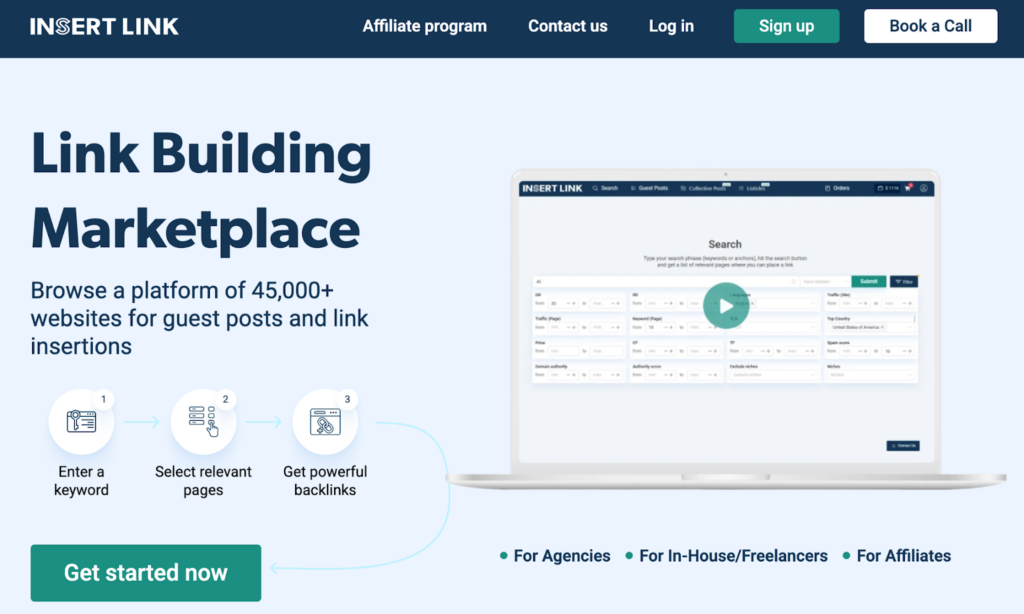
That preview cuts hours of manual inspection. You read the surrounding content immediately. You decide if the page fits your topic without clicking away to check the site yourself.
- Links first, pay later means you review the live link before funds leave your account. No paying for something that never shows up.
- NLP search groups publishers by actual content context. A site about accounting software stays separate from general finance blogs. You pick pages matching your topic specifically.
- 45,000+ websites across thirty countries with all metrics visible before purchase.
Two placement types exist. Link insertions go into content already published and ranking. Guest posts require fresh articles. Insertions move faster and cost less because no new content needs writing. Prices start at around $10 for lower-authority pages. DR45 sites with steady traffic run $80 to $170.
Trustpilot shows 4.3. DesignRush and G2 both average 4.8. Users mention that the platform significantly cuts research time. For anyone seeking a best link building marketplace that removes the hunting phase, INSERT.LINK delivers.
2. FatJoe: Outreach Work Vanishes
FatJoe runs differently than self-serve platforms. You do not browse a catalog and click buy. Instead, you describe what you need. Their team handles the outreach. Real people pitch publishers. Real people follow up.
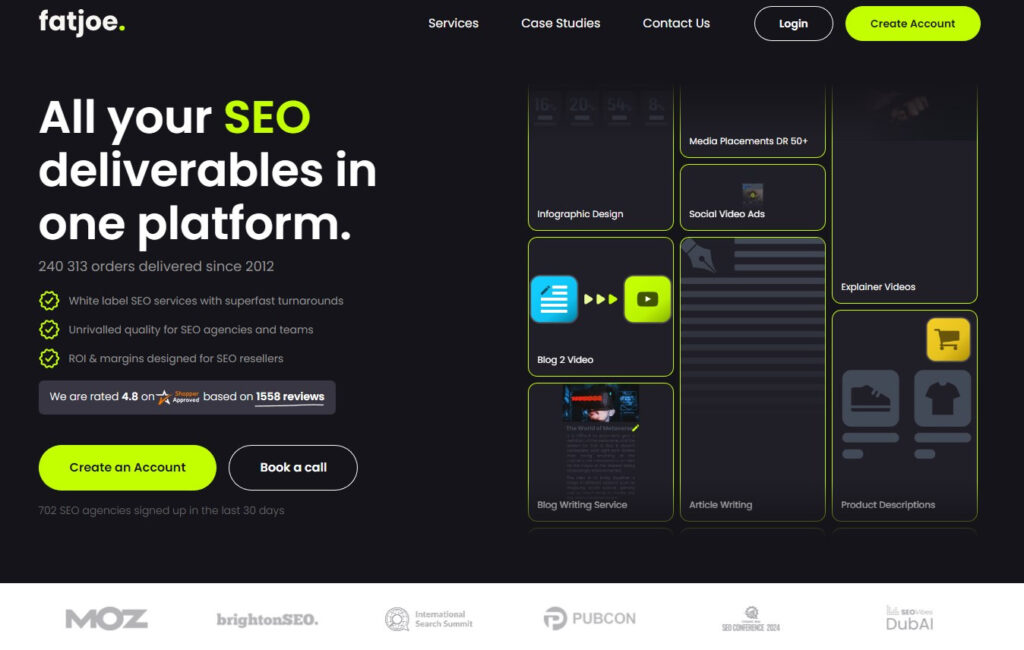
This removes the most time-consuming part of link building. No writing pitches. No waiting for email replies. No negotiating prices with site owners.
- Flat-rate pricing means you know exactly what each link costs before ordering. No surprises at checkout.
- Publisher relationships run deep. FatJoe has operated long enough that they work with site owners directly rather than scraping lists.
- You approve sites before they move forward. No links appear without your sign-off.
Pricing runs on tiers based on authority levels. Entry-level placements start around $79. Higher authority packages scale up. The team finds placements, handles negotiations, and delivers the finished link.
For anyone searching best backlink marketplace who actually wants to outsource the whole process, FatJoe delivers. You trade dashboard time for human conversations. Some people prefer that trade.
3. Meup: European Publisher Vetting Done For You
Meup focuses on European markets. Their inventory covers France, Spain, Italy, Germany, and other European countries. English-language options exist but the strength lies in local publisher relationships.
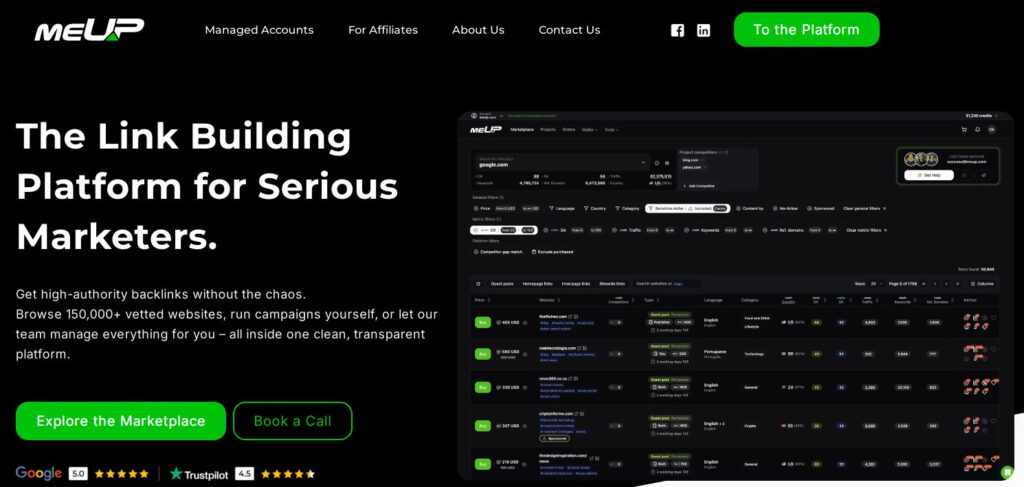
Payment runs on a credit system. You buy credits upfront. Each placement costs a set number of credits based on domain authority and traffic. Credits never expire. You can hold them while planning campaigns.
- Publisher vetting happens before sites enter the inventory. You are not guessing whether a site actually exists or accepts links.
- Local language support matters. Their team understands European publisher expectations and guidelines.
- Exact pricing in credits with no bidding. You see what a placement costs and click purchase if it fits.
The platform handles content creation if needed. Their writers produce articles that match publisher guidelines. You approve the text before submission.
For anyone targeting French, Spanish, or Italian markets, Meup functions as a straightforward link building marketplace platform. The credit system takes minutes to understand. Publishers get vetted before listing. You save hours of manual research on foreign-language sites.
4. Bazoom: Strategy Time Compressed
Bazoom positions itself as an extension of your team rather than just a link catalog. The difference shows in the details. A dedicated client manager checks in regularly. Support runs 24/7 with over eighty people available. Their AI scans your site and suggests specific pages to target.
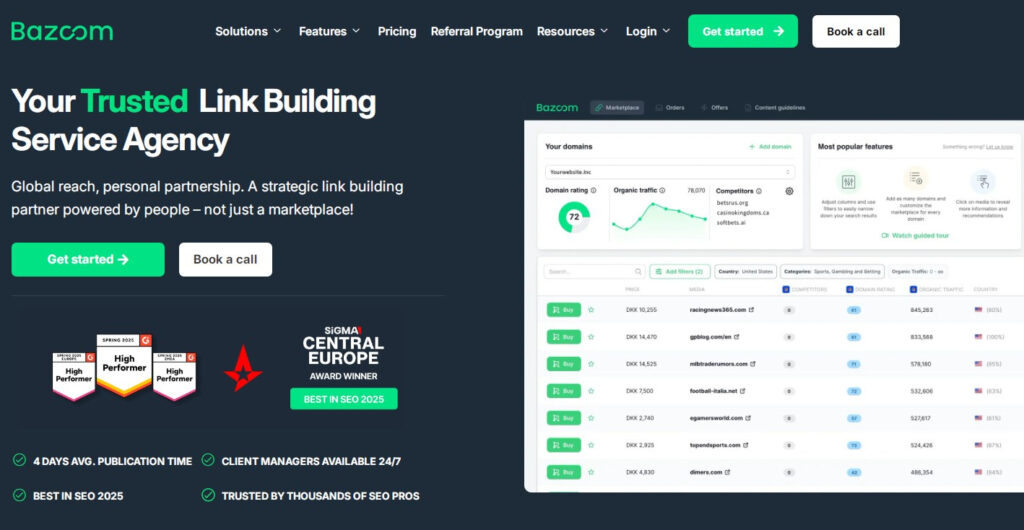
This removes strategy time. You do not sit wondering which pages need links most. Their system analyzes your site and makes recommendations.
- Dedicated client manager learns your niche and suggests targets based on actual performance data.
- All-inclusive pricing covers content writing, publication, and management. No line items for extras.
- AI scans your site and returns specific page recommendations. You approve or adjust.
Average publication time runs four days. Their intelligent marketplace pulls metrics from Ahrefs, Moz, and Semrush. You filter by the same numbers you already trust.
Thousands of SEO professionals use them. For SEO pros who want guidance, this matters. You are not alone with a dashboard. Someone can build a full strategy if you are stretched thin.
Pricing runs custom based on your needs. They focus on enterprise and agencies with larger budgets. But the human support changes the experience entirely. For teams wanting a true SEO backlink marketplace with hand-holding, Bazoom fits.
5. The Hoth: Order Management at Scale
The Hoth has operated since 2010. They processed over 100,000 orders. That scale shows in their infrastructure. The dashboard handles high volumes smoothly. You can track dozens of orders without losing context.
This saves time through organization. No spreadsheets. No manual tracking. Everything lives in one dashboard.
- Tiered pricing lets you pick authority levels that match your budget. Entry-level starts around $44.
- Content creation comes standard with most packages. Their writers produce articles that publishers accept. You review and approve before submission.
- Subscriptions discount the per-link price for recurring work. Payment works on a one-off basis or through subscriptions.
Their link building splits into tiers. You tell them what domains to target or let their team find matches based on your niche. If a publisher requests revisions, their team handles it.
The main trade-off involves speed. Turnaround runs 10 to 21 days depending on the tier. You are not getting links overnight. But the process requires zero effort beyond initial setup. Approve sites. Approve content. Links appear.
For agencies managing large volumes of client work, The Hoth functions as reliable infrastructure. You pay for predictability and scale. It is a practical backlink marketplace tool for teams that need consistency.
6. Linkhouse: Competitor Research Time Eliminated
Linkhouse launched in 2014. Their inventory reflects that longevity. The database holds 75,000+ domains across twenty-five languages. European coverage stands out. German, French, Spanish, and Italian markets have deep selections.
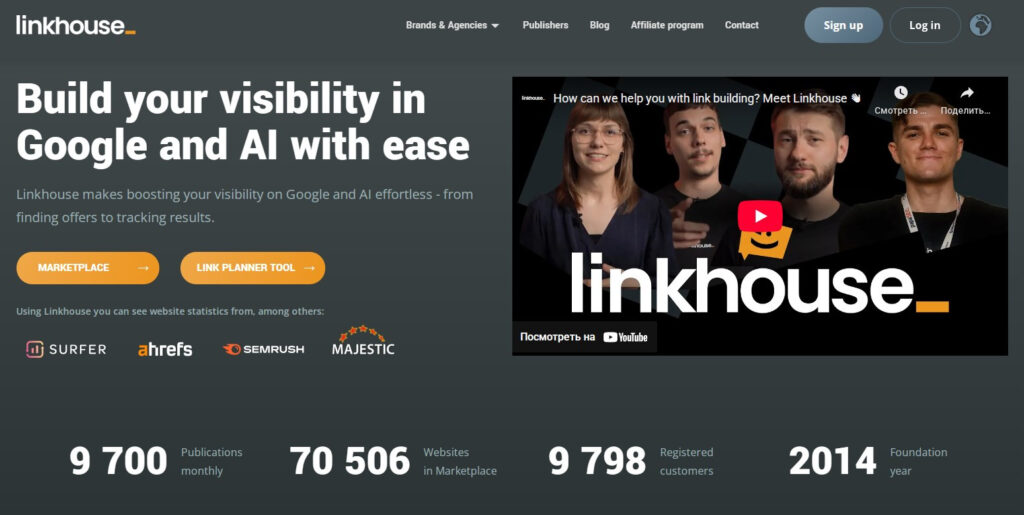
Their Backlink Gap Tool changes how you find opportunities. Enter your domain and a keyword. The tool pulls competitor data from Ahrefs, Semrush, and Google simultaneously. It shows every portal where competitors have marketplace backlink opportunities available for purchase through their platform. Analysis and acquisition happen in one place.
- Buy directly from competitor results. You see exactly where competitors built links and purchase those same placements from the same screen.
- Multi-language inventory with deep European coverage. Thousands of options in German, French, and Italian markets.
- Filter by competitor count to focus on domains linking to multiple competitors in your space.
Pricing starts around $9.99 for basic placements. Copywriting runs from €29. Higher authority domains scale up based on metrics. You filter by competitor count, domain authority, and relevancy to focus on domains linking to multiple competitors.
For data-driven teams wanting full competitor profile analysis without manual research, Linkhouse removes steps. It functions as both a research tool and an link building marketplace in one interface. The time saved on competitor analysis alone justifies the platform for many users.
Where the Time Savings Actually Show Up
Different platforms save time at different stages. Here is where each one cut hours for us.
- INSERT.LINK saved research time. Scanning millions of pages manually would take days. Their search returns relevant options in seconds.
- FatJoe saved outreach time. No pitching. No follow-ups. No negotiations. Their team handled all conversations.
- Meup saved foreign-language research time. Vetting European publishers without speaking the language normally takes forever. Their inventory removed that friction.
- Bazoom saved strategy time. Their AI suggested which pages needed links. Their manager guided the whole process.
- The Hoth saved management time. Tracking dozens of orders across spreadsheets disappeared. Everything lived in their dashboard.
- Linkhouse saved competitor research time. Pulling competitor data from multiple tools and matching it against available inventory happened in one screen.
Common Questions About Time and Budget
Before committing cash, most buyers ask the same things. Here is what we learned from testing.
Which platform saves the most money?
INSERT.LINK has insertions starting around $10. Linkhouse placements begin at $9.99. The Hoth packages start at $44. Lowest entry points exist on platforms where you do more selection work yourself.
Which platform saves the most time?
Bazoom and FatJoe remove the most manual work. Their teams handle strategy or outreach. You approve and move on.
Can you see pages before paying on these platforms?
INSERT.LINK shows full article previews. Meup displays domain metrics. Linkhouse shows domain authority and traffic estimates. The Hoth provides site lists for approval. FatJoe and Bazoom share options during the process.
What happens if a link disappears?
Presswhizz guarantees replacements for twelve months but they are not in this list. Among these six, Linkhouse replaces links lost due to publisher issues. The Hoth and FatJoe handle replacements case by case. INSERT.LINK processes replacements within one week based on our testing.
Wrapping Up
Some platforms save research hours. INSERT.LINK shows you pages instantly. No manual hunting through search results.
Others save outreach time. FatJoe handles conversations with publishers. You approve and move on.
European campaigns need different tools. Meup covers French, Spanish, and Italian markets with vetted publishers and local language support.
Teams needing guidance appreciate Bazoom. Dedicated managers learn your niche. AI suggests specific pages to target.
High-volume agencies rely on The Hoth. Their dashboard processes dozens of orders smoothly. Turnaround runs predictable.
Data-driven buyers prefer Linkhouse. Competitor analysis and link purchase happen in one screen. No switching between tools.
Pick the stage where you spend most of your time. Research. Outreach. Strategy. Management. Competitor analysis. Match the platform to that bottleneck. Run three to five links through them. See which link building marketplace platforms actually remove hours from your weekly routine. That is how you separate time-saving tools from time-wasters.